Helge Landmark
The CallerHelge Landmark is a fifty-nine-year-old man living with a relentlessly advancing illness that has taken his mobility and begun to compromise his breathing. Once a tall, broad-shouldered aeroplane mechanic who took charge of things, he now depends on his wife, Astrid Landmark, for daily care. When a hearse arrives at their home as part of a cruel deception, Helge’s response complicates the scene: the vehicle frightens him, but meeting its attendants also gives him a brief opportunity to speak and act on his own terms.
Identity and Progressive Illness
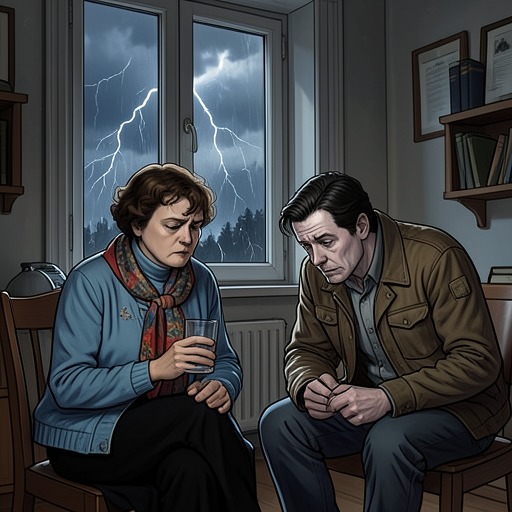
Helge is introduced in a wheelchair, his body made visibly vulnerable by the progression of his paralysis. His legs are bare and bluish-white, unable to support him; his thin, matted hair and hands resting on the chair’s wheels add to the impression of a body losing its capacities. A thick plastic tube in his neck signals that the illness has reached the muscles around his lungs and that he needs help breathing. These details are first observed by Johnny Beskow, who watches Helge and Astrid from outside their garden. The food on their table remains untouched as Astrid attends to him, pouring drinks, holding a cup to his mouth, wiping his chin and cheek, and adjusting a pillow.
At home, Helge is placed in front of the television, but he cannot follow the programme and dozes in its blue light. The illness advances upward through his body; Helge and Astrid understand that swallowing, speaking, and breathing will become impossible. His voice already has little strength, and even clearing mucus from his airway is difficult. Later, a catheter and oxygen tank are among the equipment of everyday life. The narrative makes this decline concrete through the altered uses of the home and the care his body requires, rather than treating disability as an abstract condition.
Marriage and the Work of Care
Astrid, who has recently turned fifty-three, is Helge’s principal caregiver. She met him when she was nineteen and remembers the strong, playful man who took care of things. That memory stands against the present: she struggles to look him in the eye, and much of what they might need to discuss—including death, burial, and the future of their home—has become difficult to say aloud. Even ordinary future phrases, such as another Christmas or another time, are closed to them because they know Helge may not live to see them.
Care also fills Astrid’s hours with tasks that cannot resolve what is happening. She irons shirts that are already smooth from the dryer, plans more laundry, bread-making, and housework, and keeps herself busy while Helge sits in his wheelchair. The activity gives her a temporary refuge from the truth and, she feels, lets him remain quiet. When he asks for help lying down, she gets an hour’s reprieve; he cries against the bedroom wall while she watches television and sobs. Later, she hears mucus gurgling in his throat and grips the ironing board, trying to be the patient, encouraging wife she believes she ought to be. Alongside love and duty, she experiences despair, anger, and resentment at the illness and at Helge’s decline. She fears that he can perceive these feelings, even when she does not say them.
The Hearse at the Window
The arrival of a black hearse at the Landmarks’ home turns Helge’s private confrontation with death into an unnerving public spectacle. Astrid sees the cross on the roof and panics, above all because she does not want Helge to see the vehicle. He has already heard it and is unsettled by visitors; he tries to manoeuvre his wheelchair toward the window despite the effort it costs him. When he asks whether someone is coming and whether they will have to come inside, Astrid quickly tells him they will not. The reassurance cannot hide the hearse, which remains in the driveway with its engine barely audible.
The incident brings the funeral-home men into the couple’s lounge. Helge is initially caught in a scene that seems to confirm the fear already surrounding him, but he does not remain only its passive object. He tells the men that, when his time comes, he would like to be driven in their car. The room falls silent; then they cross to him and take his hand, and one replies that it would be an honour and a pleasure. In that exchange, the hearse changes from an imposed threat into something Helge can address and make a request of. The response does not undo the deception or his illness, but it gives him a moment of recognition and control.
Brief Agency and Return to Dependence
After meeting the funeral-home men, Helge asks Astrid for cognac and feels, for a while, almost like a man again. He has caught the visitors off guard, and the encounter lifts his spirits. The pleasure is real but short-lived: the drink leaves him drowsy, with heavy eyelids and a spinning head. He returns to the wheelchair, catheter, oxygen tank, and physical weakness. The contrast is sharp. His request about the hearse briefly lets him direct how he might meet his death; the ordinary requirements of illness soon reassert themselves.
When Inspector Konrad Sejer asks whether anyone has harassed the couple before, Helge is unable to respond. Sejer’s strength and fitness embarrass him, reminding him of the life he once had and of the dignity he feels he has lost. Yet Helge’s earlier words to the funeral-home men prevent his character from being reduced to helplessness: even amid fear and bodily dependence, he can answer the prospect of death with a choice of his own. The hearse scene makes that agency fragile and temporary, but not imaginary.